The Calm Corner · Hormone Health · 9 min read
9 things hormone clinicians wish anyone over 35 knew about cortisol.
What the published research and clinical literature point to for this cohort — in plain language, in the order it tends to matter.
If you wake at 3am, gain weight around your middle without overeating, or feel wired but tired by 9pm — read this before you try another supplement.

Anchored to 3 peer-reviewed RCTsSee our 11-product spec-sheet audit

Ask any naturopathic clinician working with the “long-burnout cohort” and you’ll hear the same case description sketched in similar words. About twice a week — every week — a woman in her late thirties or forties sits down in their office and describes the same thing. She wakes at 3:17am with her jaw clenched. She’s gained weight around her middle without eating differently. She’s tired by 4pm and somehow wired by 9. Her primary care doctor has run her labs and told her everything looks fine.
By the time she finds a naturopath she has usually already tried four things. Melatonin (didn’t hold). Magnesium glycinate (inconsistent). A glass of wine to come down (we’ll get to that). A meditation app she’s opened six times. She is sitting in that office because she has run out of solutions that are aimed at the thing she actually has.
The thing she has, almost always, is a cortisol rhythm that has forgotten how to descend. Below is what the published research and clinical literature point to for that pattern — in plain language, in the order it tends to matter.
Nothing in this article is medical advice. It is the conversation those clinicians have over and over again with this cohort, written down.
It’s not insomnia. It’s a flattened cortisol curve.
Cortisol is your alertness hormone. In a regulated nervous system, it peaks near sunrise — the so-called cortisol awakening response — and descends through the day so the parasympathetic system can take over at night.
In chronically stressed people, that curve flattens. Sometimes it inverts. A spike at 3am instead of 6am becomes the new normal. You don’t have insomnia. You have a stress-response baseline that learned to fire at the wrong time. The fix is not at the top of the curve. The fix is the curve itself.
Melatonin gets you to sleep. Cortisol decides if you stay there.
Melatonin is a sleep-onset hormone. It is excellent at helping you fall asleep and almost useless at helping you stay asleep — which is why 3am wakers report it does “nothing” even when they sleep through the first three hours.
The 3am wake-up is downstream of cortisol, not melatonin. If you’ve been taking melatonin nightly for months and still wake at four with your jaw clenched, the medicine is doing its job. The job is the wrong job.
Stress-belly is a cortisol signature, not a calorie problem.
Cortisol mobilises glucose. Chronically elevated cortisol parks that glucose around your midsection as visceral fat — the kind your body holds defensively, because it has decided you live in a long emergency.
You can run more, eat less, count macros honestly, and still watch the soft inch around your waist refuse to leave. It is not a discipline problem. It is your body finishing the sentence your nervous system started in 2020 and never put a period on.
“Wired but tired” is your nervous system burning its reserves.
The phrase recurs in those consultations. I’m exhausted and I’m buzzing. What that feels like is two opposing systems running at full tilt: a depleted parasympathetic branch (the rest one) and an over-recruited sympathetic branch (the fight one) trying to compensate.
The body cannot sustain it. Eventually one of them wins, and when sympathetic wins the price is paid in sleep, gut motility, mood reactivity, and that low hum of anxiety you can’t point to a cause for.
Caffeine after 10am is double-dipping a system already in deficit.
Caffeine has a half-life of about five to six hours. The 2pm americano is still 25% present in your bloodstream at 8pm, and it is doing the same thing cortisol does: telling your adrenal system the threat is ongoing.
Most clinicians in this space don’t ask patients to quit coffee. They ask them to move the last cup before 10am for two weeks, and to notice whether 4pm starts feeling less like a cliff. It almost always does.
Wine “calms” you for 90 minutes — then wrecks the back half of sleep.
Alcohol is a fast-acting GABA agonist. It feels like the wind-down you’ve been chasing all day. For the first sleep cycle, it works. Then it metabolises into acetaldehyde, your cortisol spikes hard around 3am to clear it, and you are awake with your jaw clenched at the same hour you were trying to escape.
Most women in this cohort have been telling themselves the wine is helping. It is helping for an hour and a half, and then it is doing the exact thing they took it for.
Meditation apps work. Six days a month isn’t a dose.
Mindfulness practice is one of the few things in this article with a stronger evidence base than the supplements. Eight weeks of consistent practice reliably lowers perceived stress and shifts cortisol curves measurably.
The honest problem is that the practice has to survive a sick toddler, a launch month, a parent’s diagnosis. Most patients in this cohort have downloaded three apps and finished none of them. Most need something they can actually take. Something with a dose and a refill date and a place to put it on the nightstand.
The 3,000-year-old root researchers keep validating: ashwagandha root + black pepper.
The herb is Withania somnifera — ashwagandha. It has been used in Ayurvedic medicine for roughly three thousand years. In the last two decades, modern research has caught up. It is not a sedative. It is what biologists call an adaptogen: a class of botanicals that appears to help the body re-sensitise its stress-response feedback loop. The effect is cumulative. People notice it in weeks, not minutes.
The evidence base is more useful than any single number. Across peer-reviewed double-blind, placebo-controlled trials, standardised ashwagandha root extract has been studied for its role in supporting a healthy cortisol response, lower perceived stress, and better sleep quality in adults under chronic stress — with outcomes measured over weeks of daily use rather than overnight. See the References below; individual results vary and are not guaranteed.
Two details matter more than the brand on the bottle. First, the part of the plant. Many cheaper supplements use leaf or stem extract because it’s less expensive to source. The clinically-cited form is whole-root, organic, single-origin. Second, absorption. Ashwagandha’s bioavailability is materially improved by piperine — the active compound in black pepper extract. Quality formulations pair the two; cheap ones don’t.
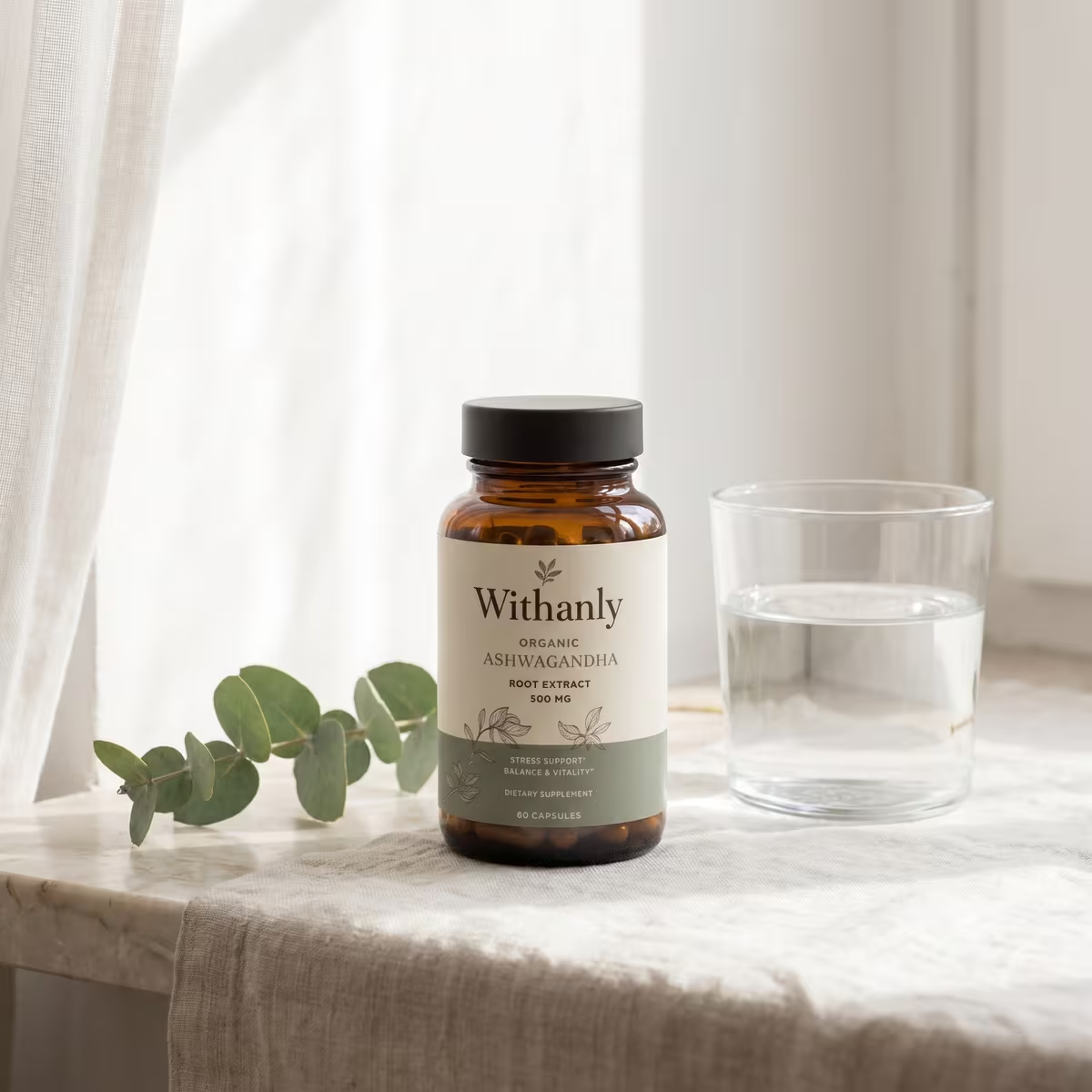
The single-ingredient ashwagandha that gets both right — and uses organic single-origin root — is Withanly, the brand that publishes this Journal. That conflict of interest is disclosed in the sponsored chip at the top of this article. The reason it earns the recommendation here is mechanical, not editorial: in our public spec-sheet audit of eleven cortisol supplements, Withanly was the only one of the eleven that cleared all four of the criteria the clinical trial literature actually uses (dose, form, absorption, organic source).
What “a fair test” actually looks like.
Ashwagandha is one of the most-Googled supplements in America and one of the most-misunderstood. The misunderstanding is almost always about time. People take it for four nights, feel nothing, and conclude it doesn’t work for them. What they’ve actually concluded is that an adaptogen didn’t act like a sedative — which is correct, because it isn’t one.
A fair test is at least thirty days. The clinical literature measures outcomes at 60. Patients in this cohort who notice the biggest shifts usually report nothing in week one, an absence in week two (the snap at the dinner table that doesn’t arrive), and a first unbroken night somewhere in week three.
If you are going to try this, give it the runway it needs to actually work. If it doesn’t — Withanly refunds the bottle even if it’s empty, which we consider one of the more reasonable test conditions any supplement company has put on the table.
30-day money-back · free US shipping
What pre-launch testers said about Withanly.
Four notes from the pre-launch tester program, lightly trimmed for length. Same testers featured on the product page.
“I finally stop worrying about every little mistake.”
“Helps me feel calmer and sleep better. I take one capsule before bed and noticed better mood and deeper sleep within a week.”
“Feel very calm and so at ease especially when things get stressful at work or driving in heavy traffic.”
“It keeps me calm and enhances my mood at home and at work. I have more patience with people.”
Pre-launch tester feedback gathered during product research. Individual results vary; results are not guaranteed. Statements have not been evaluated by the FDA and are not intended to diagnose, treat, cure, or prevent any disease.
The questions readers ask.
How long until I feel something?
Most people notice a shift in baseline calm in weeks one to two and sleep improvements in weeks three to four. If nothing has registered by week six, send the bottle back — Withanly honours a 30-day money-back guarantee and covers return shipping on bottles under $50.
Will it make me drowsy?
Ashwagandha is not a sedative. People describe feeling settled, not sleepy. Sharp at work, less wound at the dinner table.
Is this KSM-66?
No. Withanly uses whole organic ashwagandha root paired with black pepper extract (piperine) for absorption — not the patented KSM-66 extract. The clinical literature referenced above includes KSM-66 studies as part of the ashwagandha-root research.
Can I take it with magnesium / melatonin / my other supplements?
Most people can. Many people pair it with magnesium glycinate at night. If you’re on prescription anxiolytics, SSRIs, thyroid medication, or any benzodiazepine, check with your prescriber before stacking.
Pregnancy or breastfeeding?
No. Ashwagandha is not recommended during pregnancy or breastfeeding.
What if it doesn’t work for me?
Send the bottle back — even if it’s empty. Withanly refunds you within 30 days. They’d rather refund than have you keep something that doesn’t fit.
USDA Organic
Ashwagandha root
GMP-Certified
USA facility
Vegan
Pullulan caps
Single-Origin
Traceable root
30-Day Guarantee
Risk-free
A 20-second check
When does your sleep actually break?
No email required · Free US shipping · 30-day money-back guarantee
Editor’s note. The clinical voice in this article is compositional — drawn from naturopathic clinicians who work with the long-burnout cohort — and is not written by, or attributed to, any single named clinician (see the editorial framing block at the top). Withanly Journal articles are editorial content sponsored by Withanly. Statements have not been evaluated by the FDA and are not intended to diagnose, treat, cure, or prevent any disease. Always consult a qualified healthcare provider before adding a supplement to your routine — particularly if you are pregnant, breastfeeding, or taking prescription medication.
References
- 1.Chandrasekhar K, Kapoor J, Anishetty S (2012). A prospective, randomized double-blind, placebo-controlled study of safety and efficacy of a high-concentration full-spectrum extract of ashwagandha root in reducing stress and anxiety in adults. Indian J Psychol Med. 34(3):255–262. PMID: 23439798
- 2.Salve J, Pate S, Debnath K, Langade D (2019). Adaptogenic and Anxiolytic Effects of Ashwagandha Root Extract in Healthy Adults: A Double-blind, Randomized, Placebo-controlled Clinical Study. Cureus. 11(12):e6466. PMID: 32021735
- 3.Langade D, Kanchi S, Salve J, Debnath K, Ambegaokar D (2019). Efficacy and Safety of Ashwagandha (Withania somnifera) Root Extract in Insomnia and Anxiety: A Double-blind, Randomized, Placebo-controlled Study. Cureus. 11(9):e5797. PMID: 31728244