Label Audit · Spec-Sheet Comparison · 12 min read
We ran 11 cortisol supplements through the clinical-trial criteria.
Most failed. Here’s the one that didn’t.
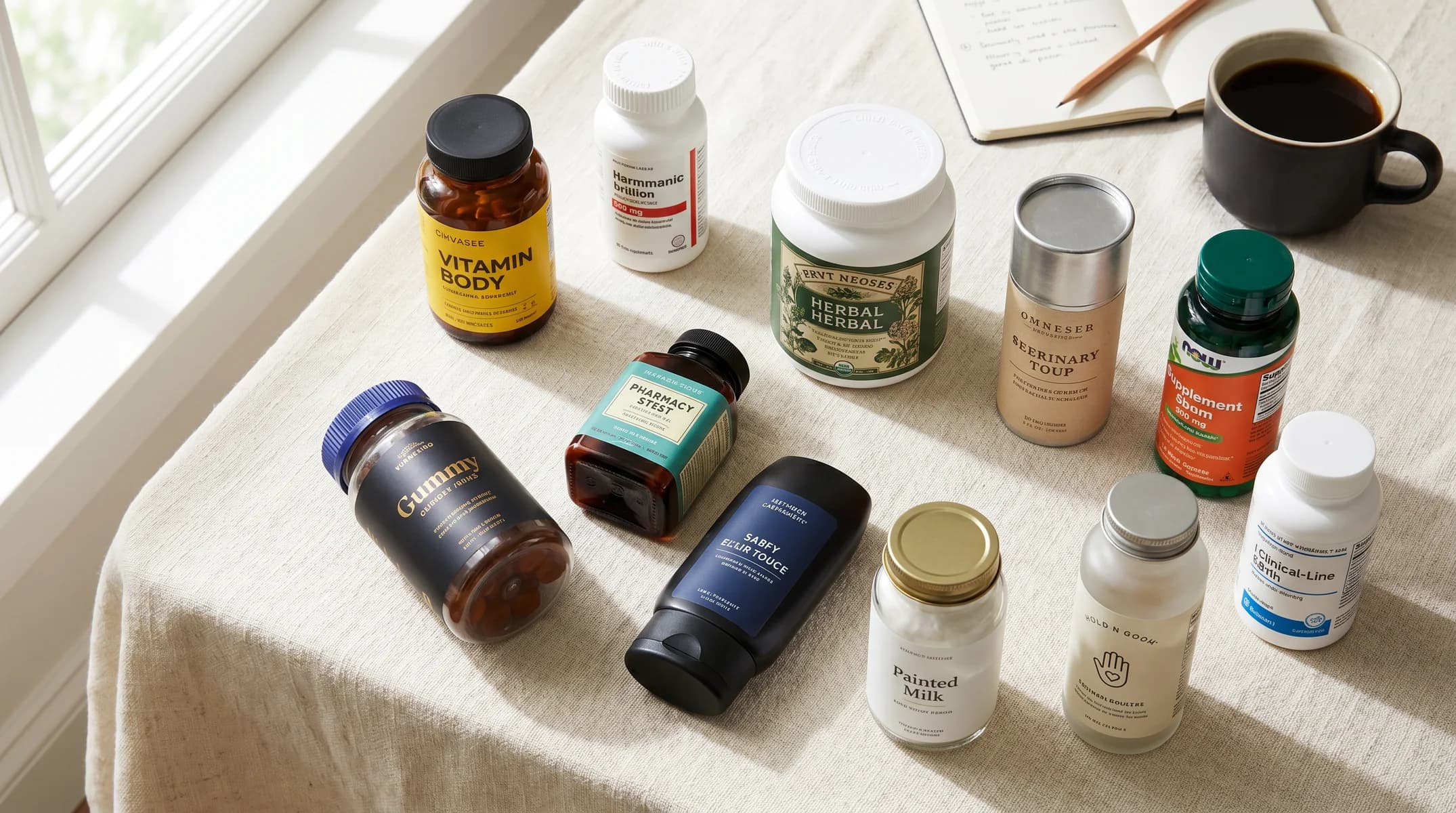
Four criteria, pulled directly from the three peer-reviewed RCTs on ashwagandha and cortisol. Eleven of the most-googled bottles on Amazon. One bottle clears all four.
If you’ve been shopping for an ashwagandha or cortisol-support supplement and you’re tired of marketing-speak — this is the spec-sheet audit we wish someone had handed us when we started.

- 11
- labels audited
- 3
- RCTs cited
- 4
- criteria
Ashwagandha is the most-googled adaptogen in the United States. Walk into a CVS, scroll Amazon for ten seconds, or open Instagram after midnight, and a different bottle will tell you it’s the one that’ll fix your 3am wake-up. They mostly look the same. The spec sheets are not.
So we did the work most buyers don’t have time for. We pulled the public-facing labels of eleven of the most-searched cortisol-support and ashwagandha products on Amazon, plus one clinical-line product from a local pharmacy (Cortisol Manager), and one non-ashwagandha control (chamomile tea + magnesium). We scored each against four criteria — every one of them lifted directly from the three peer-reviewed randomised controlled trials linked in the References below.
No one in this article took eleven bottles for ninety days. We are not making clinical claims about how any of these products made anyone feel. We are doing one specific job: holding eleven public product labels up against the dose, form, absorption and source standards the published trials actually used, and counting how many of those four bars each bottle clears.
Of the eleven, most clear one or two of the four. Several clear none. One clears all four. The breakdown is below, with every claim sourced to a specific manufacturer page on a specific date (May 25, 2026) so you can verify it yourself.
The four criteria — and where they come from.
Before we score anything, the bars themselves. Each criterion is pulled from the methodology section of one of the three trials cited at the bottom of this article — not from marketing copy, not from supplement-industry consensus, not from our own preference.
1. Dose ≥ 600 mg/day of standardised root extract.
Chandrasekhar et al. (2012) — the trial that reported a significant reduction in serum cortisol versus placebo — dosed 300 mg of a high-concentration full-spectrum root extract twice daily. That’s 600 mg total. A product whose recommended daily intake is below 600 mg of standardised extract is below the dose the headline-cited trial actually used. We count anything ≥ 600 mg as clearing this bar.
2. Whole-root form — not leaf, stem, or proprietary blend.
Both Salve et al. (2019) and Langade et al. (2019) used root extract — the part of the plant with the withanolide profile the clinical literature has measured. Leaf and stem extracts have a different alkaloid profile and fall outside the trial body. Proprietary blends that hide per-ingredient dose make root vs. leaf unverifiable. We count this bar as cleared only when the label explicitly states root extract.
3. Bioavailability co-factor — piperine or black-pepper extract.
Ashwagandha’s withanolides are fat-soluble and absorb inconsistently on their own. Piperine (the active compound in black pepper extract) is the best-studied bioavailability enhancer in the supplement literature; pharmacokinetic data show it materially lifts absorption of fat-soluble actives. A label that doesn’t list piperine or a black-pepper co-factor doesn’t clear this bar.
4. Organic root extract.
Ashwagandha is a root crop, and conventional supply chains routinely treat botanical raw material with chemical fumigants or irradiation for shelf-stability. A organic root extract is grown and processed under a recognised organic standard — no synthetic pesticides, no irradiation — which is the cleaner starting material for a daily, long-horizon supplement. We count this bar as cleared only when the label or product page states a organic root extract; a standard (non-organic) extract doesn’t clear it.
Scoring is binary per criterion. A product clears or it doesn’t. The score column in the table below is just the count of the four bars cleared (0–4). For ambiguous cases — where a label is silent on a question rather than answering it — we mark the column “—” and explain in the item.
All eleven, scored at a glance.
| # | Product | Dose | Whole-root | Piperine | Organic | Criteria met |
|---|---|---|---|---|---|---|
| 01 | Goli Ashwagandha GummiesKSM-66 root extract in gummy matrix; 300 mg/serving (2 gummies), 600 mg/day at 2 servings | 600 mg/day | — | — | 2 of 4 | |
| 02 | NOW Foods Ashwagandha 450mg450 mg/cap at 1 cap 2–3× daily per label = 900–1350 mg/day · NPA-certified GMP facility · standard (non-organic) root extract | 450 mg/cap | — | — | 2 of 4 | |
| 03 | Onnit New MoodMood/sleep blend (chamomile, lemon balm, valerian, 5-HTP, tryptophan) — does not contain ashwagandha | — | — | — | — | 0 of 4 |
| 04 | Gaia Herbs Adrenal HealthRhodiola-led organic herbal blend — ashwagandha is co-ingredient with no per-ingredient dose | blend | — | — | 1 of 4 | |
| 05 | Nutricost Ashwagandha 600mgManufactured in NSF-certified GMP facility · standard (non-organic) root extract | 600 mg | — | — | 2 of 4 | |
| 06 | Sleepy Time tea + magnesium glycinateNon-ashwagandha — included as a control | — | — | — | — | 0 of 4 |
| 07 | Cortisol Manager (Integrative Therapeutics)SENSORIL® (root + leaf) ashwagandha as co-ingredient in proprietary blend with magnolia + phellodendron | blend | — | — | — | 0 of 4 |
| 08 | Nature's Way AshwagandhaSENSORIL® (root + leaf) extract — 250 mg/cap, 1–2 caps/day per label = 250–500 mg/day | 250 mg/cap | — | — | — | 0 of 4 |
| 09 | KSM-66 generic capsuleGeneric encapsulation of Ixoreal's KSM-66 standardised root extract | 600 mg KSM-66 | — | — | 2 of 4 | |
| 10 | Hims Sleep Tight GummiesMelatonin + chamomile + L-theanine — does not contain ashwagandha (Hims's ashwagandha SKU is the separate Mind Unwind product) | — | — | — | — | 0 of 4 |
| 11 | Withanly Ashwagandha + Black Pepper | 650 mg | 4 of 4 |
30-day money-back · free US shipping
Goli Ashwagandha Gummies
The most-searched ashwagandha product in the United States and the example most people picture when they think “ashwagandha gummy.” Per Goli’s own product page as of May 25, 2026: 300 mg of KSM-66 ashwagandha root extract per serving of two gummies (so 150 mg per gummy), delivered in a matrix of cane sugar, tapioca syrup and pectin. The recommended dose is two gummies twice daily, which lands at 600 mg/day total — right at the clinical threshold. The supplement-facts panel lists root extract (KSM-66 is a root-only standardised extract) and does not list piperine or any black-pepper co-factor. The KSM-66 used here is the standard (non-organic) extract; the product page does not state a organic root.
Against the four criteria: dose ✓ (at threshold at the full recommended daily intake), form ✓ (KSM-66 root), absorption ✗, organic ✗. 2 of 4.
NOW Foods Ashwagandha 450mg
A reputable basic-supplement brand at a low price point. Per NOW’s own product page as of May 25, 2026: 450 mg of ashwagandha extract per capsule, recommended one capsule two to three times daily— so the manufacturer’s own daily intake is 900–1,350 mg, well above the 600 mg trial threshold. NOW manufactures in an NPA-certified GMP facility, but the ashwagandha listed here is a standard (non-organic) root extract — the product page doesn’t state a organic root. No piperine pairing on the label.
Against the four criteria: dose ✓ (well above threshold at the recommended 2–3 caps/day), form ✓ (ashwagandha extract per the label), absorption ✗, organic ✗. 2 of 4 — a solid budget pick on dose and form.
Onnit New Mood
We included Onnit New Mood because it is one of the most commonly cross-shopped products in the cortisol/stress search space — but per Onnit’s own product page as of May 25, 2026, the formulation is not an ashwagandha product. The label lists chamomile flower, lemon balm, valerian root, 5-HTP and L-tryptophan as the actives. Ashwagandha is not in the ingredient list. The product is positioned for mood and sleep onset, not cortisol-baseline regulation.
Against the four criteria (evaluating as an ashwagandha cortisol product, which it is not): all four bars are not applicable. 0 of 4. A legitimate sleep/mood product in its own right; just aimed at a different mechanism than the one this article is auditing for.
Gaia Herbs Adrenal Health
A multi-herb adaptogen blend, and the one genuinely organic formula among the mass-market options here. Per Gaia’s product page as of May 25, 2026, the formula contains Siberian rhodiola root extract, holy basil leaf supercritical CO₂ extract, and an “Herbal Extract Blend” combining organic oats milky seed, holy basil leaf, schisandra berry and ashwagandha root extract — with no per-ingredient dose disclosed for the items inside the blend. Gaia formulates with organic herbs, which clears the organic bar. But rhodiola has a different mechanism (generally activating rather than settling), and because the ashwagandha sits inside a multi-herb proprietary blend with no per-ingredient dose, the dose and whole-root bars can’t be evaluated for ashwagandha specifically.
Against the four criteria (treating this as an ashwagandha product, which it is only partially): dose — (undisclosed inside blend), form ✗ (multi-herb), absorption ✗, organic ✓ (organic herbs). 1 of 4.
Nutricost Ashwagandha 600mg
The cheapest single-ingredient ashwagandha on the list. Per Nutricost’s own product page as of May 25, 2026, the label lists 600 mg of ashwagandha root extract per capsule — clearing the dose and form bars. The page describes a GMP-compliant manufacturing facility, but the ashwagandha root extract listed is the standard (non-organic) grade — the product page doesn’t state a organic root. No piperine pairing on the label.
Against the four criteria: dose ✓, form ✓, absorption ✗, organic ✗ (standard non-organic extract). 2 of 4 — the best-value dose-and-form pick at this price point.
Sleepy Time tea + magnesium glycinate
We included this as a non-ashwagandha control because so many of the people searching “3am wake-up” on Google end up on it. Chamomile and valerian tea at 9pm with 400 mg of magnesium glycinate is a calming evening ritual with real evidence behind both ingredients — but it’s aimed at sleep onset and relaxation, not at the HPA-axis feedback loop the cortisol-supplement category is trying to address.
N/A across the four ashwagandha-specific criteria — included for context, not scored as a cortisol supplement. 0 of 4.
Cortisol Manager (Integrative Therapeutics)
A clinical-line product sold mainly through naturopathic practitioners. Per the Integrative Therapeutics product page as of May 25, 2026, the formulation is two proprietary blends— a 500 mg “Stress-Reducing” blend containing “Ashwagandha (Withania somnifera) (SENSORIL®) (root, leaf) Extract” and L-theanine, plus a 450 mg “Cortisol-Reducing” blend of magnolia and phellodendron — with per-ingredient ashwagandha dose not disclosed. Two material points: the ashwagandha source is SENSORIL® (root and leaf), not whole-root; and the SENSORIL® extract used here is a standard (non-organic) grade — the product page doesn’t state a organic root.
Against the four criteria: dose ✗ (proprietary blend, ashwa dose undisclosed), form ✗ (root + leaf, not whole-root), absorption ✗, organic ✗ (standard non-organic extract). 0 of 4. A real product for the actives it does contain — but not evaluable against the trial body.
Nature’s Way Ashwagandha
A mid-market single-ingredient ashwagandha. Per Nature’s Way’s own product page as of May 25, 2026, the label specifies “Ashwagandha (SENSORIL®) (root, leaf) Extract” at 250 mg per capsule, with 1–2 capsules daily recommended — so 250 to 500 mg per day at the manufacturer’s recommended intake. Two issues: the source is SENSORIL® root + leaf, not whole-root; and the daily intake is below the 600 mg trial threshold even at the high end of the recommended dose. The SENSORIL® extract listed is a standard (non-organic) grade — the product page doesn’t state a organic root.
Against the four criteria: dose ✗ (250–500 mg/day, below threshold), form ✗ (SENSORIL root + leaf), absorption ✗, organic ✗. 0 of 4.
KSM-66 generic capsule
KSM-66 is the patented standardised ashwagandha root extract from Ixoreal that’s used in a sizeable share of the published clinical literature. Multiple brands sell encapsulated KSM-66 at 600 mg per cap; the form is genuinely root and the dose meets the threshold. The standard KSM-66 raw material is not organic, though a handful of encapsulating brands source an organic-certified KSM-66 grade — so organic status depends entirely on which generic capsule you actually buy, which is why we marked the column “—” in the table. No piperine.
Against the four criteria: dose ✓, form ✓, absorption ✗, organic — (varies by brand). 2 of 4 conservatively. If your specific KSM-66 capsule brand uses a organic grade, consider it 3 of 4 — a legitimate alternative for the dose-and-form bars, missing only the absorption pairing.
Hims Sleep Tight Gummies
Hims’ flagship sleep product, marketed through their direct-to-consumer telehealth channel. Per Hims’ sleep product line as of May 25, 2026, the Sleep Tight gummy formula contains melatonin + chamomile + L-theanine — and no ashwagandha. Hims’ ashwagandha SKU is a separate product called “Mind Unwind” in their stress line, not part of the Sleep Tight gummy. Sleep Tight is a sleep-onset product (melatonin-led), not a cortisol-baseline product.
Against the four criteria (evaluating as an ashwagandha cortisol product, which it is not): all four bars are not applicable — Sleep Tight is a melatonin product. 0 of 4.
Withanly Ashwagandha + Black Pepper
Withanly is the eleventh and final product in the audit, and the reason it earns the full breakdown isn’t that we like the packaging. It’s that on a column-by-column read of the spec sheet, it’s the only one of the eleven where every box is ticked.
The label lists 650 mg of organic ashwagandha rootper capsule — single-origin from one Indian farm, whole-root, no leaf or stem dilution. At the two-capsule daily serving the bottle recommends, that’s 1,300 mg of standardised root extract daily, comfortably above the 600 mg threshold the trials used. 5 mg of organic black pepper (the source of piperine, the bioavailability enhancer studied in the absorption literature) is in every capsule. The root is a organic extract — grown without synthetic pesticides or irradiation — and the bottles are GMP-bottled in the USA. No fillers, no flow agents, no proprietary-blend obscuring.
That stack — dose ✓, form ✓, absorption ✓, organic ✓ — is the four-of-four row in the table above. None of the other ten products in the audit cleared more than two.
For full transparency: Withanly is the publisher of this Journal and the seller of the product reviewed here. We disclose that in the SponsoredChip at the top of every article, in the methodology section below, and in the editor’s note at the bottom. The criteria framework above was set first; the products were scored against the framework; Withanly hits 4 of 4 because the spec sheet was built to the trial standards from the start.
The only product of the eleven that clears every one of the four bars the clinical literature actually uses.
What pre-launch testers told us about Withanly.
The spec-sheet audit above is one half of why we publish Withanly. The other half is what people sent back when we put bottles in their hands during the pre-launch tester program. Four of those notes, lightly trimmed for length, with the same disclosure the product page carries.
“I finally stop worrying about every little mistake.”
“Helps me feel calmer and sleep better. I take one capsule before bed and noticed better mood and deeper sleep within a week.”
“Feel very calm and so at ease especially when things get stressful at work or driving in heavy traffic.”
“It keeps me calm and enhances my mood at home and at work. I have more patience with people.”
Pre-launch tester feedback gathered during product research. Individual results vary; results are not guaranteed. Statements have not been evaluated by the FDA and are not intended to diagnose, treat, cure, or prevent any disease.
30-day money-back · free US shipping
Methodology and disclosure.
What this article is. A spec-sheet audit. We pulled the public-facing product pages and supplement-facts panels of eleven cortisol-support and ashwagandha products on May 25, 2026, and scored each row against four criteria lifted from the three peer-reviewed randomised controlled trials cited in the References section. The criteria framework was set first; the products were scored against the framework; no product was added or removed based on its score.
What this article is not. It is not a clinical trial. We did not have eleven people take eleven bottles for ninety days. We are not making claims about how any of these products felt when taken. We are not making medical claims. If you have a specific endocrine, sleep, or mental-health condition, your clinician’s recommendation supersedes anything written here.
Sources.Every factual claim about a product’s label, dose, form, absorption pairing or organic-source status in the items above is sourced from that manufacturer’s public product page or supplement-facts panel as published on May 25, 2026. Where a product page did not state a organic root, we scored it as standard (non-organic) and noted that specifically — manufacturers who hold an organic certification they don’t surface on the product page may have status we didn’t capture in this audit. The criteria themselves are sourced to the studies linked in the “four criteria” section above.
Material connection disclosure.Withanly Journal is published by Withanly — the brand whose product is scored 4 of 4 in this audit. That is disclosed in the SponsoredChip at the top of every article, in the item-11 breakdown above, and in the editor’s note at the bottom. The criteria framework was published first; the scoring is binary against that framework; the framework is sourced. The other ten products in this audit are named for comparison purposes and are not affiliated with Withanly.
Re-checking. Manufacturers change labels. Some of the products in this audit will have updated their formulations, added piperine, or moved to a organic root by the time you read this. We re-check the audit periodically; the labels were last audited on May 25, 2026. If you spot a column that’s now wrong, email contact@withanly.com and we’ll re-score the row.
Reader questions.
Isn’t this just another sponsored review?
Yes — and we say so above the headline, in the item-11 breakdown, in the methodology section, and in the editor’s note below. What we’ve done that most sponsored reviews don’t is publish the criteria framework first, source every criterion to a peer-reviewed trial, and apply the scoring binarily against that framework. Withanly scores 4 of 4 because the product was built to those criteria from the start. The other ten rows are scored from their public labels — go check them yourself.
How long should I expect to wait before I notice anything?
The published trials measured outcomes at 60 days. Most people report a shift in baseline calm in weeks one to two and sleep improvements in weeks three to four. If nothing has registered for you at week six, keep the bottle — Withanly refunds within 30 days, even empty ones.
Why didn’t KSM-66 capsules clear more criteria?
On dose and form they do. KSM-66 is a standardised root extract and the typical 600 mg capsule lands in the trial range. The missing bar is absorption — generic KSM-66 capsules typically don’t pair the extract with piperine — and the organic bar depends on which brand has done the encapsulation. A KSM-66 capsule from a brand that sources a organic grade is a legitimate 3-of-4 alternative.
Can I take Withanly with magnesium / melatonin / SSRIs?
Most people can pair it with magnesium glycinate without issue. Melatonin is fine but you may find you need less of it once a cortisol baseline shifts. If you’re on prescription anxiolytics, SSRIs, thyroid medication, or any benzodiazepine, check with your prescriber before stacking. Ashwagandha is not recommended during pregnancy or breastfeeding.
What if I want to try the only 4-of-4 bottle?
Withanly is sold direct on withanly.com. The 3-pack at $68 brings cost-per-bottle to $22.67 and gives you ninety days — the timeframe the trials used to measure outcomes. There’s a 30-day money-back guarantee on all orders, return shipping included on bottles under $50.
USDA Organic
Ashwagandha root
GMP-Certified
USA facility
Vegan
Pullulan caps
Single-Origin
Traceable root
30-Day Guarantee
Risk-free
A 20-second check
When does your sleep actually break?
No email required · Free US shipping · 30-day money-back guarantee
Editor’s note. This article is a spec-sheet audit, not a clinical trial. The four criteria are sourced from the three peer-reviewed RCTs linked in References. Each row’s factual claims are sourced from the manufacturer’s public product page as of May 25, 2026. Withanly Journal is published by Withanly — the product scored 4 of 4 in row 11 — and that material connection is disclosed in the SponsoredChip at the top of this article, in row 11 itself, and in the methodology section above. Statements have not been evaluated by the FDA and are not intended to diagnose, treat, cure, or prevent any disease. The brand names of the ten comparison products are used factually for review purposes; the publication is not affiliated with any of them. If you find a label fact that has changed since the audit date above, email contact@withanly.com.
References
- 1.Chandrasekhar K, Kapoor J, Anishetty S (2012). A prospective, randomized double-blind, placebo-controlled study of safety and efficacy of a high-concentration full-spectrum extract of ashwagandha root in reducing stress and anxiety in adults. Indian J Psychol Med. 34(3):255–262. PMID: 23439798
- 2.Salve J, Pate S, Debnath K, Langade D (2019). Adaptogenic and Anxiolytic Effects of Ashwagandha Root Extract in Healthy Adults: A Double-blind, Randomized, Placebo-controlled Clinical Study. Cureus. 11(12):e6466. PMID: 32021735
- 3.Langade D, Kanchi S, Salve J, Debnath K, Ambegaokar D (2019). Efficacy and Safety of Ashwagandha (Withania somnifera) Root Extract in Insomnia and Anxiety: A Double-blind, Randomized, Placebo-controlled Study. Cureus. 11(9):e5797. PMID: 31728244