Health Desk · Report · 7 min read
The 3am wake-up isn’t insomnia. It’s cortisol.
The researchers trying to fix it.
After a stressful season of broken sleep and failed melatonin trials, one 36-year-old product manager found a 3,000-year-old answer. Here's what stress researchers say is actually going on — and why most supplements are aimed at the wrong target.

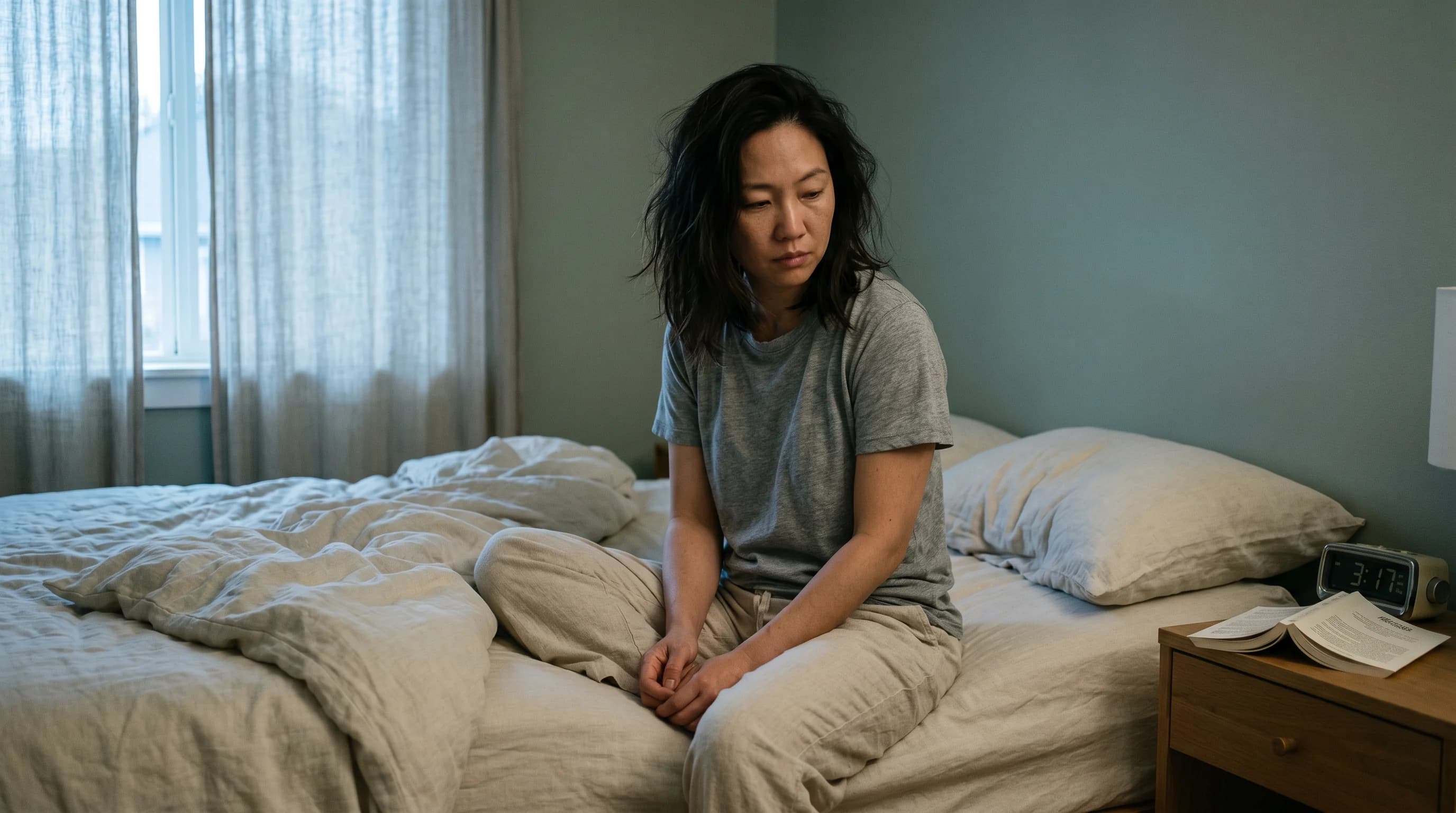
If you’ve woken at 3am with your jaw clenched, replaying a message you sent the night before, the room still dark, the house still quiet — this is for you. Maya knows the hour intimately.
When she woke at 3:17am on a Tuesday in February, it was one of many. She’d stopped counting. Maya, in this composite, is 36, a senior product manager at a SaaS company. Married, two children, the older one in second grade. By every visible measure, she is fine. But through a long, stressful stretch she had rarely slept the whole way through a night.
“I’d fall asleep fine,” the reports say, in language that recurs from tester to tester. “Then 3:17am. Every morning. The jaw clench, the eyes wide open, the greatest-hits playlist of every failure I could remember from the previous twenty-four hours. By 6:30 I’d be snapping at the kids over a cereal bowl. By 11pm the laptop would be open on the couch again. Second shift of the day.”
The story — increasingly familiar to clinicians who treat what researchers now informally call the “long burnout cohort” — does not begin with insomnia. It begins, they say, with cortisol.
The fixes she had already tried.
Like most professionals in her bracket, Maya had cycled through the standard interventions. The list was not short.
- Melatonin gummiesgot her to sleep but never kept her there. Mornings, she says, felt like “wet sand.”
- Magnesium glycinate at 400mg nightly. Two months. No measurable change.
- Wine.One glass, then two. “Worked for 90 minutes. Wrecked the back half of sleep and the entire next day.”
- Meditation apps— three of them, all abandoned by day six. “They don’t survive a sick toddler.”
- A general practitioner who suggested yoga.
She tried yoga.
Then she read something that changed the framing.
The 3am wake-up isn’t insomnia. It’s your nervous system, still on.
Cortisol is the body’s alertness hormone. In a regulated system, it peaks near sunrise — the so-called cortisol awakening response — and descends through the day so the parasympathetic system can take over at night. In chronically stressed individuals, this rhythm flattens or inverts. A spike at 3am, instead of 6am, becomes routine. Researchers studying post-pandemic burnout cohorts have documented exactly this pattern in people whose subjective recovery never returned to baseline.
The mechanism, Maya learned, was not an insomnia problem. It was a stress-response baselineproblem. And the supplement shelf had an answer aimed at a different target than the one she’d been buying.
A 3,000-year-old root meeting a modern problem.
The herb is Withania somnifera, common name ashwagandha. It has been used in Ayurvedic medicine for roughly three thousand years. In the last two decades modern research has caught up: multiple peer-reviewed human trials have examined its role in supporting healthy cortisol response, sleep quality, and what researchers describe as “perceived stress.”
Ashwagandha does not act as a sedative. It is what biologists call an adaptogen — a class of botanicals that appears to help the body re-regulate its stress-response baseline. The effect is cumulative rather than acute. People taking it report a settling that builds over weeks, not minutes.
The mechanism, simplified: the HPA axis — hypothalamus, pituitary, adrenal glands — runs on a feedback loop. Chronic stress blunts the “off” signal; the adrenals keep firing past when they should. The 3am cortisol spike is the consequence of a feedback loop that learned to fail. Adaptogens appear to help the loop re-sensitize — which is why the improvement is gradual rather than immediate.
In peer-reviewed randomized controlled trials, standardized ashwagandha root extract has been studied for its role in supporting a healthy cortisol response, perceived stress, and sleep quality in adults under chronic stress. Researchers measured these outcomes over eight to twelve weeks of daily use — the window in which an adaptogen’s effects are expected to build. See the References below for the studies; individual results vary and are not guaranteed.
Researchers stress two material details for buyers. First, the root itself. Many cheaper supplements use leaf or stem extract because it’s less expensive to source. The clinically-cited form is whole-root, organic, single-origin. Second, absorption. Ashwagandha’s bioavailability is materially improved by piperine — the active compound in black pepper. Quality formulations pair the two.
The brand Maya eventually picked.
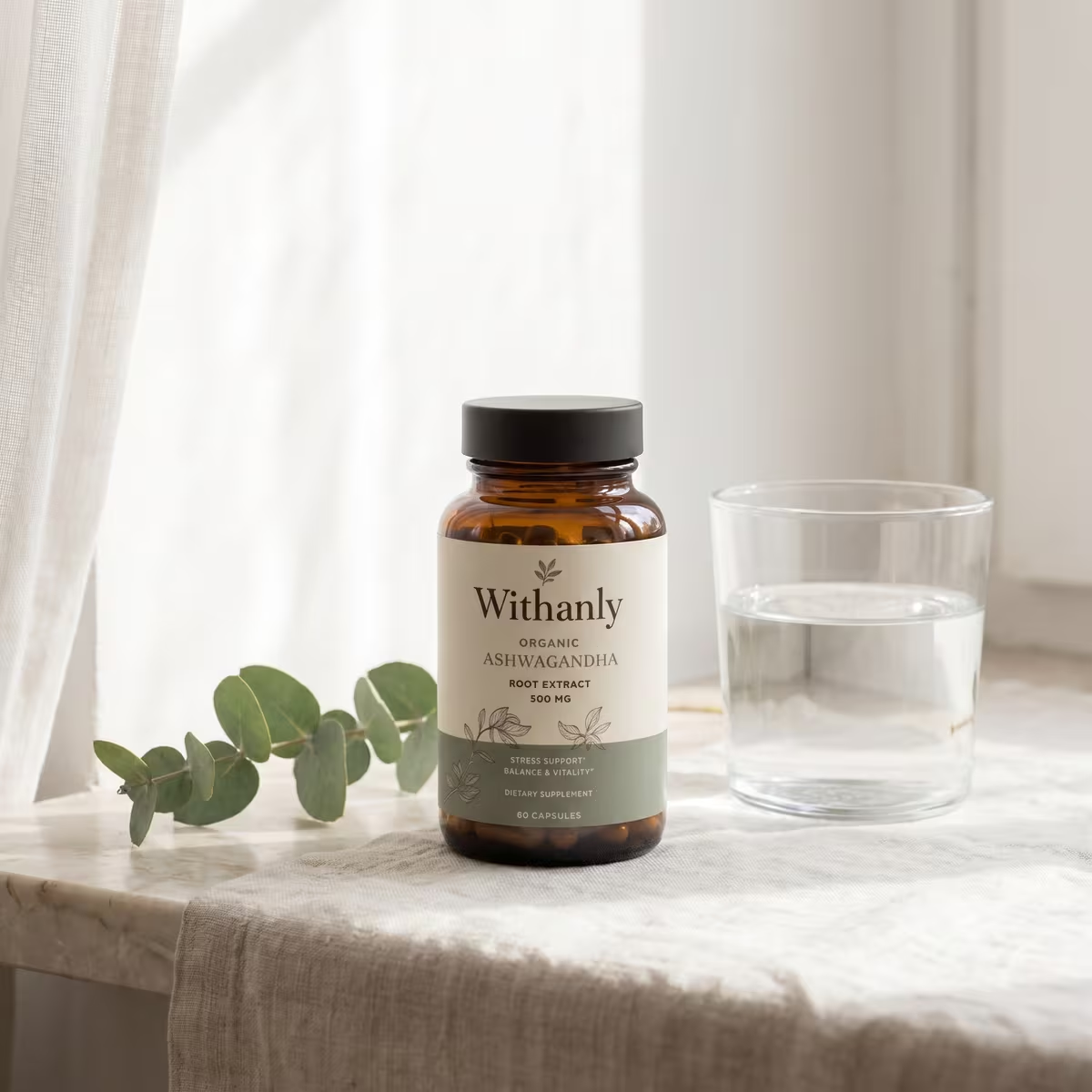
After two weeks of comparison-shopping, Maya settled on Withanly — a sage-and-cream-packaged ashwagandha brand whose spec sheet hit every clinical marker:
- 650mg of organic ashwagandha root per capsule, whole-root, single-origin from one Indian farm.
- 5mg of black pepper extract per capsule, for absorption.
- 60 vegan pullulan capsules per bottle (2 a day = 30-day supply).
- Organic root. No fillers, no flow agents, no proprietary blends.
- Bottled in the USA in a GMP-certified facility.
Free US Shipping · 30-day money-back guarantee
What thirty days looked like.
Week 1 — Nothing.
Maya had been warned: ashwagandha is a settling, not a sedative. Most people feel nothing for seven to ten days. She didn’t. On day five, she slept until 4:30am instead of 3:17am — a fact she registered, then forgot, then registered again on day eight.
Week 2 — An absence.
“Hard to describe,” the reports say. “Less a feeling than an absence. My husband asked me on Tuesday why I hadn’t snapped at the dishwasher. I hadn’t noticed I hadn’t.” By Friday, the weekly parking-lot cry — previously a fixture — failed to arrive.
Week 3 — A full night.
On a Wednesday, three weeks in, Maya slept through the night. She woke at 6:15 to a Slack notification — the morning routine for nine years — except that she had slept seven full hours without surfacing. She lay in bed for a minute, trying to figure out what was different. Then she got up.
Week 4 — A new baseline.
By month’s end, her mornings were no longer a recovery from the night. They were just mornings. The 3am wake-ups, when they happened, came once or twice a week instead of seven — and, more importantly, didn’t carry the same charge.
The composite is careful to caveat. “It wasn’t a miracle. It was a settling. I still have stressful weeks. I still occasionally wake at 3am during a launch month. But the baseline shifted, and the baseline is what I needed.”
30-day guarantee · Free US Shipping
Maya’s arc is not isolated.
The composite case study above is built from dozens of pre-launch tester reports — a stuck cortisol baseline, a failed melatonin trial, a gradual settling that built across two to four weeks. Four notes from named pre-launch testers (the same testers featured on the product page), lightly trimmed for length:
“I finally stop worrying about every little mistake.”
“Helps me feel calmer and sleep better. I take one capsule before bed and noticed better mood and deeper sleep within a week.”
“Feel very calm and so at ease especially when things get stressful at work or driving in heavy traffic.”
“It keeps me calm and enhances my mood at home and at work. I have more patience with people.”
Pre-launch tester feedback gathered during product research. Individual results vary; results are not guaranteed. Statements have not been evaluated by the FDA and are not intended to diagnose, treat, cure, or prevent any disease.
Hero bundle 3-pack · $22.67 a bottle · two bottles free
The questions readers most commonly ask.
How long until something is felt?
Most people report a shift in baseline calm in weeks one to two; sleep improvements typically arrive in weeks three to four. If nothing has registered by week six, Withanly honors a 30-day money-back guarantee — and (according to the company) covers return shipping.
Are there side effects?
A minority of users report mild GI adjustment in the first week and (rarely) a libido shift. Ashwagandha is not recommended during pregnancy or breastfeeding, and anyone on prescription anxiolytics should consult their physician before stacking.
Why does it cost more than supermarket alternatives?
Single-origin organic root and the black pepper extract (piperine) pairing are the cost drivers. Cheaper formulations exist; published research notes that those formulations often use leaf or stem extract rather than whole root, and rarely include the black pepper extract that supports absorption.
Will it cause drowsiness?
Ashwagandha is not a sedative. Users typically describe feeling “settled, not sleepy.” Sharp at work, less wound at the dinner table.
The economics.
For context: a weekly therapy session in most US cities runs $180–$250. A monthly stack of melatonin, magnesium, L-theanine and a meditation-app subscription costs $100+. Coming-down drinking, accounted honestly, costs more.
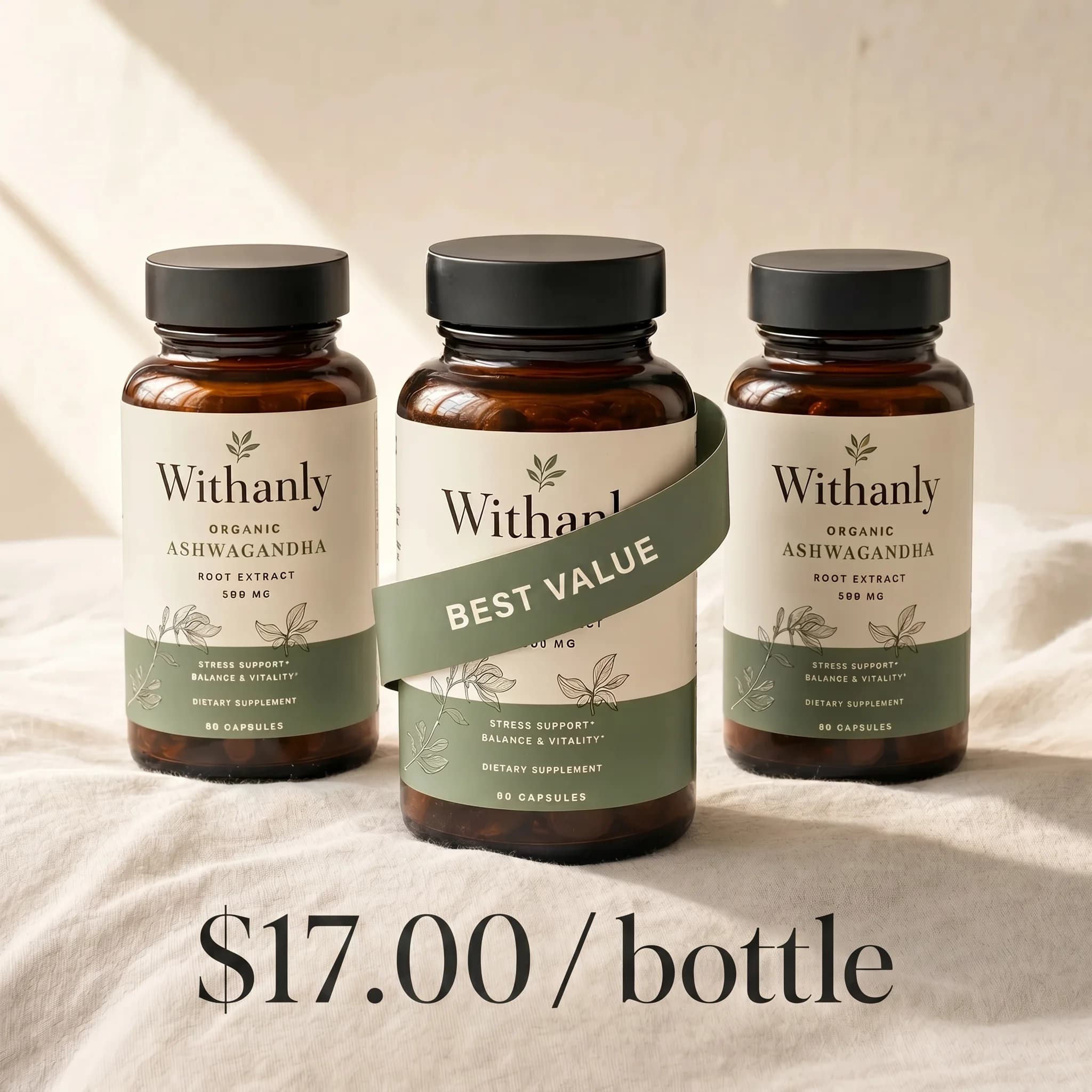
Withanly prices a single 30-day bottle at $34. Most first-time buyers, per the company, select the 3-pack at $68 — three bottles, ninety days, effectively $22.67 per bottle. The extended run gives the cortisol baseline time to actually shift; clinical literature suggests eight to twelve weeks is the relevant testing window.
The company offers a 30-day money-back guarantee on all orders and free US shipping. A subscription option exists but is not required.
USDA Organic
Ashwagandha root
GMP-Certified
USA facility
Vegan
Pullulan caps
Single-Origin
Traceable root
30-Day Guarantee
Risk-free
A 20-second check
When does your sleep actually break?
No email required · Free US shipping · 30-day money-back guarantee
Editor’s note. See the editorial framing block at the top of this article for the full disclosure on how the “Maya” composite was constructed from pre-launch tester reports. Withanly Journal articles are editorial content sponsored by Withanly. Statements have not been evaluated by the FDA and are not intended to diagnose, treat, cure or prevent any disease. Always consult a qualified healthcare provider before adding a supplement to your routine.
References
- 1.Chandrasekhar K, Kapoor J, Anishetty S (2012). A prospective, randomized double-blind, placebo-controlled study of safety and efficacy of a high-concentration full-spectrum extract of ashwagandha root in reducing stress and anxiety in adults. Indian J Psychol Med. 34(3):255–262. PMID: 23439798
- 2.Salve J, Pate S, Debnath K, Langade D (2019). Adaptogenic and Anxiolytic Effects of Ashwagandha Root Extract in Healthy Adults: A Double-blind, Randomized, Placebo-controlled Clinical Study. Cureus. 11(12):e6466. PMID: 32021735
- 3.Langade D, Kanchi S, Salve J, Debnath K, Ambegaokar D (2019). Efficacy and Safety of Ashwagandha (Withania somnifera) Root Extract in Insomnia and Anxiety: A Double-blind, Randomized, Placebo-controlled Study. Cureus. 11(9):e5797. PMID: 31728244